
Why integrate IoT into new cooler production?
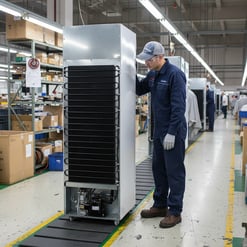
Integrating IoT during manufacturing gives OEMs a faster, more reliable path to connected fleets. By embedding hardware at the factory, you reduce retrofit work in the field, standardize quality, and ensure each cooler leaves production already visible within connected software.
 Lower total cost: Eliminates separate retrofit visits and duplicated labor.
- Faster time-to-value: Coolers connect on day one, enabling immediate monitoring and insights*.
- Better quality and data: Factory placement and calibration of sensors improves accuracy and consistency.
- Streamlined operations: Standard work at the line and documented test results simplify audits and support.
- Customer experience: End users receive ready-to-connect assets with alerts, dashboards, and reporting from the start.
*Depends on SIM card activation at factory.
Key components within the AoFrio IoT solution
- SCS Controller: The central device that collects sensor data and manages communication inside the cooler.
- Monitor:
- Temperature probe(s) for product/air temperature.
- Door sensor for usage and merchandising insights.
- Inputs for additional components - Optional display, fan, motor and compressor inputs also supported.
- Connectivity options via Gateway, SCS 800 and Network Pro – best fit determined by your preferred deployment model:
- Bluetooth for local commissioning and nearby gateway/app uploads.
- Cellular for wide-area, off-site connectivity.
- Wi‑Fi where a stable network is provided.
- Harnesses and accessories:
- Pre-terminated wiring harnesses for repeatable installs.
- Antennas, brackets, and cable management clips.
- Labels/QR codes with device and asset identifiers for easy claiming in software.
- AoFrio software:
- Device onboarding: Claim or register devices via QR code or device ID and link them to the correct cooler asset, customer, and site.
- Configuration management: Apply profiles (sensor mapping, sampling intervals) and set alert thresholds, time zone, and naming conventions.
- Data verification and insights: Confirm live telemetry (temperature, door events, signal) and view dashboards/insights to validate asset performance individually or as a fleet.
- Health, location, and commissioning checks: Review last-seen timestamps, connectivity status, and run simple functional tests (e.g., door-open event) before shipment.
 More detail: