
Overview
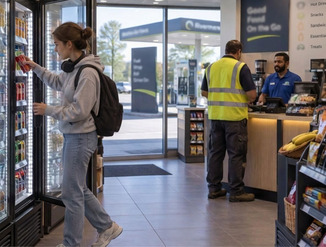
Every time a shopper opens a cooler door, they're telling you something. Door swing data is one of the most accurate and valuable ways to see which coolers, and which locations, are driving the most sales.
For fleet managers, the opportunity is to turn those individual door openings into fleet-wide intelligence. Collated across thousands of connected coolers, door swing activity shows where demand is strong, where assets are underused, and how performance shifts with campaigns, seasons and events. That insight lets commercial and trade marketing teams put coolers where they'll sell the most cold beverages.
This guide walks through a practical, six-step process for using door swing tracking in AoFrio iQ to optimize cooler placement and sales.
Six steps to sales-driven cooler placement
1. Connect your fleet and confirm data quality
Door swing insights are only as good as the coverage behind them. Start by making sure your coolers are connected to AoFrio iQ and reporting door activity reliably.
- Check which assets are online and reporting, and flag any that have gone quiet.
- Confirm each cooler's location, outlet and channel details are accurate, so activity can be compared like for like.
- Group assets in a way that matches how your business makes decisions, such as by region, channel, customer or sales route.
2. Establish a performance baseline
Before you can spot what's changed, you need to know what normal looks like.
- Review door swing activity over a representative period, ideally several weeks, to smooth out day-to-day noise.
- Look at daily and weekly patterns: peak trading hours, busy days and quiet periods.
- Record a baseline for each cooler and each group so future changes can be measured against it.
3. Identify high- and low-performing coolers
With a baseline in place, rank your assets by door swing activity to see where demand is concentrated.
- High performers are coolers with consistently strong activity. These are your best locations, and they may need more capacity or more frequent restocking.
- Low performers are coolers with little activity relative to similar outlets. These may be poorly positioned in-store, in the wrong outlet, or a sign of a stocking or merchandising issue.
- Compare like with like. A cooler in a busy convenience store and one in a small office will never match, so benchmark within the same channel or outlet type.
4. Layer in campaigns, seasons and events
Door swings become far more powerful when you read them alongside what's happening in the market.
- Overlay activity against promotional campaigns, product launches, public holidays, weather and seasonal shifts.
- Look at past events to see which locations responded most strongly, and by how much.
- Use these patterns to model and predict commercial performance, so you can stay ahead of demand rather than react to it.
5. Act on the insights: reposition and redeploy
This is where data turns into sales. Work with your commercial and trade marketing teams to put the findings into action.
- Move underperforming coolers to outlets or in-store positions with stronger potential.
- Add capacity, or prioritise new placements, where high performers show sustained demand.
- Test changes to in-store positioning, such as near the entrance or checkout, and compare door swing activity before and after.
6. Use activity data to drive restocking, then measure and repeat
Door swing trends are a strong signal of how quickly stock is moving.
- Prioritise replenishment for coolers showing high or rising activity, especially ahead of and during key events.
- Share insights with sales reps and distributors so route planning reflects real demand, not guesswork.
- After each campaign or event, review the results against your baseline and feed the learnings into your next round of placement and restocking decisions.