Skip to content
English
  • There are no suggestions because the search field is empty.

Parameter settings for perishable foods

This article looks at parameters and alarm settings in AoFrio’s SCS Controller and Monitor that help optimise temperature monitoring and related alarms in freezers and chillers that contain ice cream, meat, or cheese.


Target temperatures for perishables

We are working with the following common temperature targets for these perishable food types:

  • Ice cream (frozen): Best kept at or below −18°C(-0.4oF) for quality with a high-temp alarm to reduce product loss. ​(International Dairy Foods Association)
  • Meats (chilled): Best kept in a temperature band between 1–3°C(33.8oF – 37.4oF) with greater than 5°C(41oF) ​ considered as out-of-band.​ (Food Safety Inspection Service)
  • Cheese (chilled): Best kept in temperature bands by cheese variety: (Center for Dairy Research)
    • Soft & Blue Cheeses: These are more perishable and should be kept at lower, more stable temperatures, typically 2°C to 6°C (35°F - 43°F).
    • Hard & Semi-Hard Cheeses: These can tolerate slightly higher temperatures and are ideally stored in a cooler, more humid environment, such as a vegetable crisper drawer, which is often around 5°C to 10°C (41°F - 50°F).
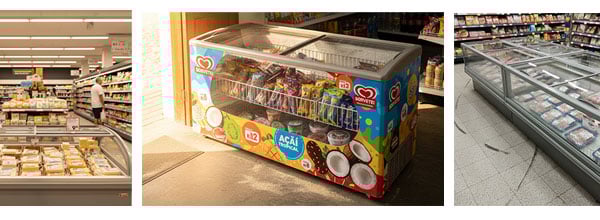
perishables


SCS Controller parameters, alarms and settings for perishables

We suggest adjusting the following settings via Field app.

Topic

Perishable

Related parameters or alarms

Normal Mode setpoint


  • Ice cream freezers: choose a setpoint that reliably keeps cabinet ≤ −18°C (-0.4oF) under load. Typical practice is to aim at or below −18°C(-0.4oF) so excursions trigger alarms before quality is at risk. ​
  • Meat chillers: choose a setpoint that keeps measured air in the 1–3°C (33.8oF – 37.4oF) band during normal operation (account for cabinet cycling and door openings). ​​
  • Cheese chillers: choose a setpoint that reliably keeps cabinet air in the 4–8°C(39.2oF – 46.4FoF) band under load (account for door openings, cheese varieties, and product mass).

  • Normal mode parameters

Temperature alarm thresholds

  • Ice cream freezers: set high-temp alarm at −15°C(5oF) (max). This gives a safety margin above the −18°C(-0.4oF) quality target. ​

  • Meat chillers: set high-temp alarm at 5°C(41oF). ​

  • Cheese chillers: set low-temp alarm at 4°C(39.2oF) and high-temp alarm at 8°C(46.4oF)

  • Low Temperature Alarm (ALr 8)

  • High Temperature Alarm (ALr 9)

Alarm delay for sustained out-of-temp events


  • A 60-minute out-of-band “sustained” out-of-temperature event is a good general starting point for alerting.

  • Temperature Out-Of-Spec Alarm Delay

Safety and diagnostics


  • Return Air Under Temp Differential: keep enabled to shut outputs off if return-air falls well below setpoint (guards against miswiring and ‘runaway’ behaviors).

  • Refrigeration system failure time: set to flag when setpoint can’t be recovered within a defined window (use the “Refrigeration System Failure Time” parameter as your escalation backstop).

  • Return Air Under Temperature Alarm (ALr 20)

  • Refrigeration Failure alarm (ALr 19)

Defrost (freezers)


  • Use the SCS defrost parameters available to you (time- or temperature-based initiation; passive/electric/hot-gas; drip time; termination). For food safety, prefer temperature-based termination to minimize heat load and set schedules outside peak trading periods. ​

  • Defrost mode parameters

Logging interval


  • SCS logging frequency: 30 minutes is a standard setting that works well in most instances, but you can increase frequency when validating a new cabinet or investigating issues (SCS supports 30–1440 min). ​

  • Logging interval


Monitor parameters and settings for perishables

We suggest adjusting the following settings via Field app.

Topic

Perishable

Related parameters or alarms

Temperature alarm thresholds

  •  Ice cream freezers: set high-temp alarm at −15°C (max). This gives a safety margin above the −18°C(-0.4oF) quality target. ​

  • Meat chillers: set high-temp alarm at 5°C(41oF).
  • Cheese chillers: set low-temp alarm at 4°C(39.2oF) and high-temp alarm at 8°C(46.4FoF)
  • High Temperature Alarm Setpoint

  • Low Temperature Alarm Setpoint

Alarm delay for sustained out-of-temp events


  • A 60-minute out-of-band “sustained” out-of-temperature event is a good general starting point for alerting.

  • Temperature Out-Of-Spec Alarm Delay

Logging interval


  • Default is 30‑minute stats blocks (minimum / average / maximum). For higher-risk products or tighter alerting, switch to ~10‑minute uploads to shorten detection time. ​​


  • Logging interval